Why being native in  matters
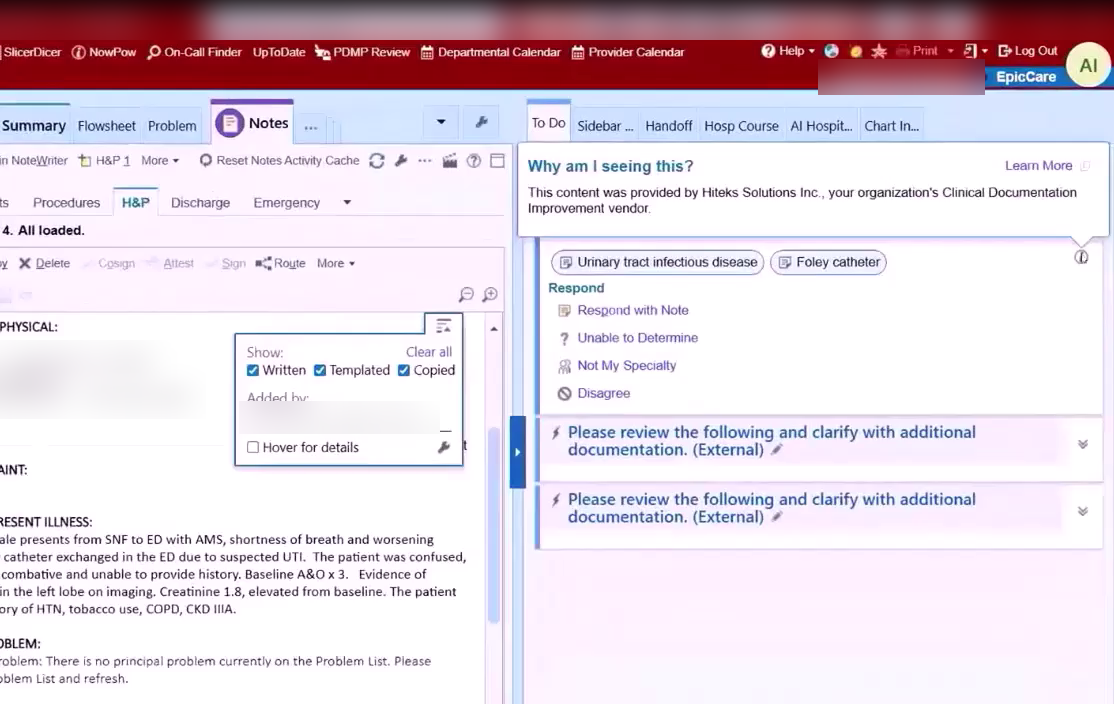
HITEKS’ Queryless CDI operates natively within Epic, providing real-time, clinically-backed guidance without requiring physicians to leave their workflow.
Inside the note
Guidance where clinicians already work.
Existing HITEKS product evidence shown in a compact editorial frame.
Key takeaways
- Stay in the workflow: Guidance appears within Epic's existing clinical documentation workflows.
- Support diagnostic specificity: Prompts ask clinicians to clarify diagnoses and the supporting evidence.
- Act at the point of care: Documentation guidance is available in real time.
When a product is natively embedded in a system, it makes everything easier. It means clinicians can use it intuitively and don’t need to learn new workflows or click into another screen to access notes or nudges. The product’s developers have already worked with the platform to ensure complexities are addressed and compliance issues are adhered to, which makes for better functionality from the user perspective.
There’s a reason why HITEKS’ Queryless CDI is native in ’s clinical documentation systems—that’s because we understand what clinicians need and what makes their lives just one step more convenient. As one of the largest health technology companies globally, is the ideal system to be settled in. We’ll explain below why being native in has made the world of difference for our clients and could make the world of difference for you.
Epic is a leading platform across healthcare
The reality is that, in the healthcare technology industry, is one of the biggest names in the game. Ninety percent of health systems ranked by Becker’s Hospital CFO Report as having the best finances use . What’s more, the majority of U.S. News and World Report’s top-ranked hospitals and medical schools also utilize . It’s clear that, whether from a financial standpoint or a traditional healthcare outcomes perspective, comes out on top.
This is also true for research hospitals that benefit from National Institutes of Health grants. The top 20 recipients of NIH grants, including Yale University, Stanford University and Johns Hopkins University, are all members of ’s community. The same goes for hospitals recognized as being on the cutting-edge of technology use in the College of Healthcare Information Management Executives’ (CHIME) Digital Health Check-Up.
Why it’s different with HITEKS
But being embedded natively in is not just a matter of convenience and superior technology. It’s also a matter of accuracy.
HITEKS’ Queryless CDI operates inherently within the environment, which both improves clinical documentation and means that hospitals and healthcare providers do not have to invest in third-party applications that add more technology burden to complete their clinical records. Physicians don’t click out of or patient records to get to their nudges or queries—guidance is already native and available in real time in the workflows in a way that is both compliant and clinically-backed. What this leads to is documentation that takes less time and makes more time available where it counts most, with patients. And when a more difficult case comes up that perhaps needs longer resolution on the CDI side, HITEKS is equipped and ready to handle that.
A common clinical example that shows HITEKS’ strengths is a patient that comes in presenting with heart failure. The relevant medications and clinical interventions supporting the unspecified diagnosis may be stated on the chart, but often, the patient’s case is not seen as sufficiently serious—if the patient documentation does not state the patient as having acute systolic heart failure, they may not show to an insurance provider as having comorbidities or complications. But if a physician documents these symptoms in , HITEKS will prompt with a nudge, asking doctors to clarify the heart failure diagnosis and list what medical evidence that statement is based on. Using this information, HITEKS can collate the chart’s already-stated indications to better support that more complete and accurate diagnosis including vital type and acuity details.
In a traditional CDI setting, the workflow may involve that of a second professional who analyzes the chart and makes improvements after its compilation and after the patient has already left. Instead, with HITEKS, the chart is analyzed in real time and made compliant usually while the patient is still present.
Perhaps HITEKS can help you improve your CDI process—if you want to know more, go to www.hiteks.com or read some of our white papers on the topic.
See Queryless CDI in action
See how HITEKS brings real-time, clinically-backed documentation guidance into existing workflows.